
The Global Pattern
NEET all around

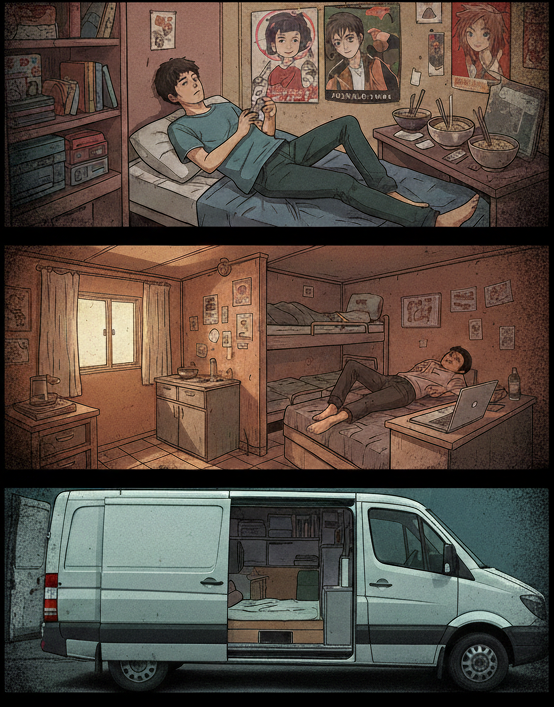
The Global Pattern
The math that said no in China is speaking every language. Our first stop is in Japan.
Japan - Hikikomori and Satori
In Japan, there is the Hikikomori and Satori. The Hikikomori, first identified in the 1990s, were young people with extreme and long‐term withdrawal and avoiding obtaining an education and a career (1). In 2017, a woman interviewed became Hikikomori (The Underground World: Living in Withdrawal from Society)
“I’d also lived as my controlling and oppressive mother had told me to, until one day I realized that there was no “me.” So I didn’t know how I wanted to live when I became an adolescent and lost track of who I was.”
Her worst time at age 26: “How did it end up like this? Why am I such a worthless human being? There’s no room for me in society.”
“For a while I was eating just two meals a day and couldn’t even bathe or brush my teeth. All I did was get up after noon, eat, excrete, and breathe. I was like a living corpse. I couldn’t find the tiniest bit of worth in myself. I thought my life was meaningless.”
According to 2022 Japanese Cabinet Office Survey on the Awareness and Lifestyles of Children and Young People (Awareness and Lifestyles of Children and Young People)” 1.46 million people suffer from Hikikomori syndrome. What makes this most troubling is the 80 - 50 problem, 80 year old parents supporting 50 year old child.
Reports of Hikikomori syndrome cases were reported in other countries including (3):
- China: 6.6%
- South Korea: 2.3%
- Hong Kong: 1.9%
- United States: 2.7%
The “Satori sedai” or “resignation generation” was first used in 2010 to describe the youth that were pessimistic of the future and not driven to materialism (Exhausted and without hope, East Asian youth are ‘lying flat).
A 25 yr old Satori who is consultant in Tokyo, “I spend my money only on things I like and find value [in]”. He is not interested in owning car or house.
Views of the Satori from associate professor of anthropology at Temple University Japan Campus: “They would do what they’re expected to do, but maybe not so much beyond that. They’re less materialistic, not so interested in consumption.”
There are no exact numbers of Satori, but estimated to be in the millions.
The difference that we are observing in Japan between the Hikikomori and the Satori is the “I can’t” versus “I won’t”.
The Hikikomori emerged from the Employment Ice Age (1993-2004) — they followed the rules, the economy collapsed, and they broke. The Satori came of age watching the results of the Employment Ice Age. They saw the generation ahead of them do everything right and get destroyed anyway. So they made a different calculation: don’t invest in a system that already proved it will fail you.
The other factor affecting young temporary workers in Japan is the pressure being exerted by companies because of chronic labor shortages. Many Japanese workers are hiring resignation agencies to quit jobs (”They refused to let me go”: Japanese workers turn to resignation agencies to quit jobs).
Head of Albatros (Resignation company): “In Japan, companies are traditionally strong …Resigning is seen as evading your responsibilities. But that is changing.”
One can understand the Satori point of view. From Japan, we continue to South Korea.
South Korea - Sampo and N-po
Besides Hikikomori being diagnosed in South Korea, we find the Sampo and N-po generations. The Sampo have shifted from the satori point of view to give up on dating, marriage and children. The generations have grown from Sampo (3 items) to N-po (n items).
The items given up by the N-po is everything.
Level 1: Sampo
Dating
Marriage
Children
Level 2: O-po
House
Interpersonal relationships
Level 3: N-po
Hope
Employment
Health
Physical appearance
Life
University student (25 yr) “n-Po” generation (omanatheydidnt): “Myself and a lot of my friends are working part-time jobs to pay for tuition. If when we graduate there wouldn’t be a problem finding a job, we could smile through the difficulties we have now. But the reality is that when we graduate, finding a job will be a real problem. Even for those friends who have found a job, they worry about getting married. The ones who got married, they worry about how to buy a home. We are calling ourselves the ‘n-Po‘ generation because we are giving up all the things that are of value in life.”
Professor of Sociology at Korea University (omanatheydidnt): “Looking at the situation here the ‘whining strategy’ becomes rampant. Young people who cannot enjoy any benefits in life are feeling angry or disenfranchised and have taken to mockery and self-depreciation. The older generation is recognized for their hard work, but the younger generation is more known for inheritance than hard work when it comes to achieving success. This way of thinking reflects the difficulties young people face today.”
Poverty rate in 2013.
- 19.7% for 18 to 24 year olds
- 12.3% for 25 to 29 year olds.
- 20.3% for 60 to 64 year old group at 20.3%.
The fertility rate (2023) in South Korea is 0.72. The population is in free fall and will soon look like Japan where the fertility rate is 1.2.
EU - NEET
Going from Asia to the West. In Europe, there is the NEET (Not in Employment, Education or Training). In the UK (2025), 1 in 8 young people (950,000) are classified as NEET (Almost one million young people still not in work or education, figures show). The rate of incidence of NEET in the UK has grown from just under 800,000 to 950,000 from 2015 to 2025.
Megan Williams works for The Spear Programme helping Neets for more than 10 years. The charity is seeing increasing numbers of young people who are struggling with their mental health and isolation.
“A lot of them are struggling to do day to day tasks like get out of bed, get washed, get dressed,” she said.
“Engaging with work and education feels very far away for a lot of them.”
One 21‑year‑old in Leeds told the BBC he’d been out of school for years, sending applications and getting nowhere, until an employability course from the Spear Programme finally gave him his first real interview practice and a sense that he might actually have a future.
In parts of Europe, ‘NEET’ has become an identity as much as a category; some young people casually describe themselves as NEET or use local slang like ni‑ni in Spain and nem‑nem in Portugal—signaling that being shut out of work and school is now common enough to joke about. (Eurydice).
Researchers tracking European NEETs find that even a short period out of work and school can leave a mark: a higher chance of future unemployment and wages that lag peers by around a fifth for as long as two decades.
US - Quiet Quitting
From the EU across the pond to the US where we find Quiet Quitting. Quiet Quitters are Gen Z and Gen X. Both are disengaging for similar reasons as those found in Hikikomori albeit on a far less stressful scale, and the Satori of Japan. Gen X has been through layoffs, restructuring, and 1990s–2000s corporate churn. Many Gen Xers describe long histories of quitting bad jobs outright or building side‑hustle and freelance survival skills instead of trusting any single employer. Gen Z on the other hand have observed this growing up and have taken more of the Satori stance, but louder with Tik Tok videos announcing the quiet quitting.
In the US, it’s called ‘quiet’ because the rebellion happens in plain sight—the body is at the desk, but the spirit has already left the building.
In 2023, Gallup reports about 32–34% of U.S. employees engaged, 16–17% actively disengaged (“loud quitting”), and the remaining ~50% in the quiet‑quitting middle (Gallup).
Quiet quitting Gen Z employees do the bare minimum at work. Doing exactly what the job description asks and nothing more—no unpaid overtime, no extra projects, no emotional over‑investment.
- A Gallup synthesis describes quiet quitters as people who “fill a seat and watch the clock,” meeting minimum requirements while being psychologically detached from their work.
- In one recent review of Gen Z workers, researchers find that mental health and life satisfaction have fallen most among those who are working, especially women under 25, and link this to poor job quality and blocked advancement (Blanchflower & Bryson, NBER, updated manuscript, and Hechinger summary).
The pattern is familiar: they did what was asked—degrees, résumés, side gigs—and discovered that the extra hustle doesn’t move the needle enough to justify the sacrifice, so they right‑size effort to the deal on offer (Hechinger) and (Gallup/CNBC on job quality).
Search for reasons why Gen X is disengaging, and what comes back reads like a corporate diagnosis looking for a corporate fix. Microsoft says 61% of Gen X managers feel overwhelmed by technology changes (Microsoft Work Trend survey summary). Deloitte says 63% are behind on retirement savings while carrying $60,000 in non-mortgage debt (summary of Deloitte findings). AARP says they’re 25% less likely to be promoted than younger colleagues despite more experience (AARP on Gen X promotions). Over half of Gen X workers are simultaneously supporting children and aging parents while working full-time, a classic sandwich-generation squeeze (Carewell / Newsweek on Gen X caregivers).
These describe the symptoms from the employer’s side of the desk. From the other side, it looks different.
Hillary Hattenbach, writing on Substack (We’re Gen X. We’re Not Capable of Quitting), describes the view from inside. She goes over her journey. “In the years that followed, I secured, thrived at, and quit several non-writing jobs in an attempt to figure out what would make me happy. I was too scared to pursue a writing career, terrified to fail.”
“Eventually, I took the leap and left my steady paycheck behind, largely because I was sick of my discontent and the ripple effect it had on other aspects of my life. And now, after a half-century on the planet, I’m finally getting paid to write. I don’t make nearly as much money as I used to working for The Man, but I love what I do. Better late than never.”
Hillary’s take on this is very similar to my own experience.
I learned from the “latch key” years about being on your own. I witnessed what the Dot.com and other economic breaks did to my parents. My father had his own business which was drained and 2008 finished it off. What was supposed to be, working for your dream could just circle down the drain. Health problems finished my father off and he never recovered financially.
The Same Equation
Five countries. Five languages. Five different governments — communist, capitalist, parliamentary, constitutional. Five different cultures with five different words for the same thing.
Tangping. Hikikomori. Satori. Sampo. N-po. NEET. Gen X Quiet Quitting.
Strip the labels away and the pattern is identical. In every country, there are two groups. The first group followed the rules, worked the hours, earned the credentials — and the economy broke them anyway. The Hikikomori. The Sampo generation. The NEETs. Gen X. They are the “I can’t” generation. Not because they lack ability, but because the system consumed their effort and returned nothing.
The second group watched that happen. The Satori watched the Hikikomori get destroyed. Gen Z watched Gen X grind for decades and come out behind on retirement with $60,000 in debt. China’s lying-flat youth watched their parents work 996 schedules (9:00 am to 9:00 pm, 6 days a week) to buy apartments that are now worthless. They all made the same calculation: don’t invest in a system that already proved it will fail you. They are the “I won’t” generation.
And every country is getting the diagnosis wrong.
China calls it “unhealthy ideas” that violate socialist values. Japan classified it as a psychiatric syndrome. South Korea’s elders call it whining. Europe reduced it to a four-letter acronym on a spreadsheet. The United States turned it into a Gallup engagement metric — a problem to be optimized, a score for consultants to fix.
Every one of those framings puts the failure inside the person. The worker isn’t engaged enough. The young person isn’t resilient enough. The generation isn’t grateful enough.
None of them are asking the obvious question: What if the people are fine and the deal is broken?
That question is what comes next. Because if five countries with nothing in common are producing the same output, the variable isn’t culture. It isn’t work ethic. It isn’t generational character.
It’s the equation itself. And that equation broke everywhere at the same time, for reasons that aren’t hard to trace if you’re willing to look.
*Next: How did the math break? The economic fractures behind the global opt-out.*
References
1. Rooksby, M., Furuhashi, T. and McLeod, H.J. (2020), Hikikomori: a hidden mental health need following the COVID-19 pandemic. World Psychiatry, 19: 399-400. https://doi.org/10.1002/wps.20804
2. Pozza, Andrea et al. “The ‘Hikikomori’ syndrome: worldwide prevalence and co-occurring major psychiatric disorders: a systematic review and meta-analysis protocol.” *BMJ open* vol. 9,9 e025213. 20 Sep. 2019, doi:10.1136/bmjopen-2018-025213
3. Eckardt, Jens Peter. “Does the Hikikomori Syndrome of Social Withdrawal Exist in Denmark? A Research Request.” *JMA journal* vol. 6,1 (2023): 86-87. doi:10.31662/jmaj.2021-0217
This article is part of the Fire in the Cave series exploring pattern recognition, ontological sovereignty, and the systems shaping human potential. The full archive, methodology, and research live at fireinthecave.com.