How Silver Price Volatility Revealed What Was Coming
And Why I Bought a Mac Instead of Waiting
What happened: Detected unusual silver market behavior in November, positioned ahead of supply disruption, Venezuela operation revealed systemic mineral competition.
The methodology: Biomarker signal → Track anomalies → Gather convergent evidence → Position before full understanding → Watch pattern reveal itself.
What you’ll learn: How to detect systemic pressure before geopolitical events make it obvious.
Biomarker
It was late December 2025, and I was watching GPU prices for a new AI workstation. The rational case for waiting was clear: prices were high ($3,500-4,000), supplies were limited, post-holiday sales might come. Every logical analysis said wait.
But the nervousness persisted. And I’ve learned not to ignore that signal.
This is how pattern recognition works when you don’t yet know what pattern you’re detecting.
This may seem not relevant, but during this time. Silver starting increasing in price. I started watching the price continue to climb from Black Friday through Christmas. Prices climbing and then dropping. Silver is known for volatility but I have observed nothing like this over the last 10 years.
I started watching more. Trying to figure out what could be a driver for this behavior. Gold and silver have long been purchased by those that worry that the amount of debt by the US Government may lead to the inflation of the currency. Recently, BRICS and other countries are decreasing their purchases of US Treasuries or de-dollarizing for transactions. These have been happening for many years and silver prices have maintained a trading range over this time.
Data centers, solar panels, EVs and batteries like Samsung’s new solid state battery have been increasing the demand for silver. Again, maybe you would observe a constant price increase over months or yearly. Not observing dollar and multi-dollar swing in prices in a day. This was new. The other is the markets are a little more complicated than looking at the stock market. For US customers, the London Bullion Market Association (LBMA) where one can buy contracts that can have metal delivered and the other is the Commodity Exchange Inc. (COMEX). The COMEX is a leading North American futures and options exchange for trading precious and base metals. You are investing or betting on price movements on COMEX. Another exchange that appeared to be playing a larger role during this time is the Shanghai Metals Market (SMM) which gives spot prices or prices for the metal. Normally, one would expect COMEX prices to be higher than LBMA or SMM prices since for COMEX you are looking at future prices and costs for storage would be included versus the present value representing by LBMA or SMM.
Market Structure Tells a Story
LBMA prices were higher than COMEX with SMM prices greater than LBMA. The spreads or differences were $4.00 or higher for SMM versus LBMA over this time. This implies that physical metal buying is driving the price and not investment products. I did not understand the mechanics behind this, but silver is a need for electrical and computer components among other important products like AI data centers, batteries, green energy technologies, electrical infrastructure. Why all of a sudden the increase in physical buying. The silver price has been gradually increasing since September 2025 going from approximately $40 to $50 over the month. For the month of November it increased another $10 over the month. From Christmas Eve to the day after Christmas, Silver price increased $8 dollars. The SMM and other exchanges had large premiums as compared to COMEX and LBMA.
Figure 1. Daily COMEX Silver Prices from February 2024 through January 5, 2026
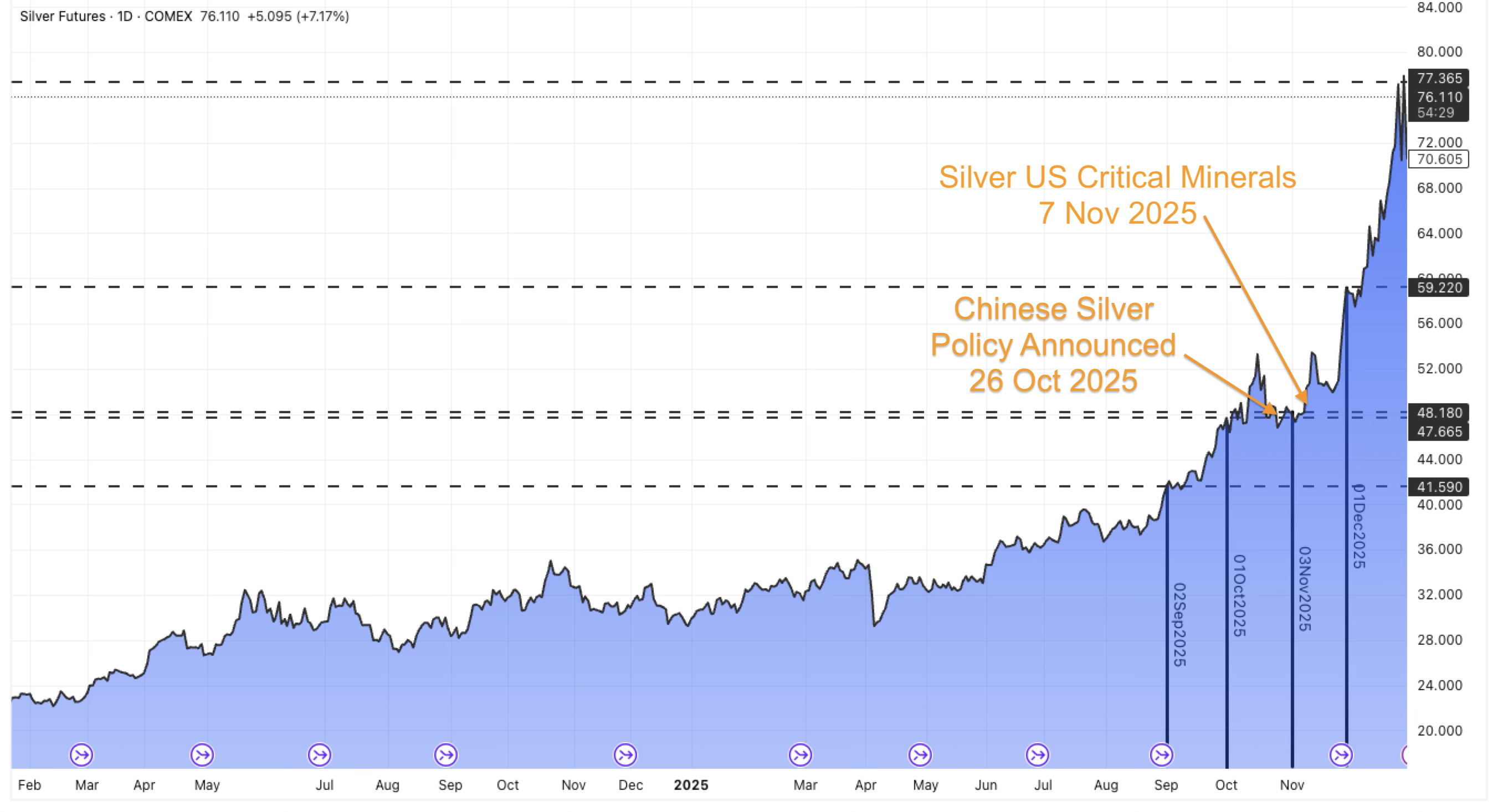
Note the unusual volatility beginning in November and the $8 spike over Christmas - behavior unlike anything in the previous 10 years.
One has to be careful with interpreting price moves over the holidays since there are fewer traders, but the SMM still had metals being purchased and driving prices up at the SMM. Normally, this would not last because someone would purchase from COMEX and LBMA and sell at the SMM to take advantage of the price differential. This was not happening. Even on the days that extreme selling seem to be happening. The price at the SMM was reduced, but still higher than either the COMEX or LBMA.
Positioning Under Uncertainty
I decided that at that point it was time to buy. I was not sure what was occurring, but knew that silver is needed for chip manufacturing. I was monitoring GPU prices and availability at a few sites. Prices did not drop after Christmas and no new supplies coming in yet. I just got lucky and an article came out in Medium. I did not read it, but the title suggested that the article was geared towards picking right LLM (Large language models) to run on your Mac. I looked at the computers that were available at the local Mac store and found an M3 Mac Studio with 96 GB memory. It is not the fastest at fine tuning new models, but for initial training it can run much bigger models than the RTX5090 can do. Also, the price for the computer was the same price as just the RTX5090 GPU. Went out and bought it.
The Signal I Didn’t Yet Understand
I made this purchase on December 26th - smart positioning based on the pattern I could see in silver markets. But I didn’t yet understand what that pattern was revealing about the system itself.
The full picture emerged over the next week.
First, more details about China’s silver policy became clear: companies needed capacity for 80+ tons annually, credit lines exceeding $30M, state approval for all exports. Combined with the US listing silver as a Critical Mineral on November 7th, industrial users were scrambling.
Then on January 3rd, the geopolitical driver became visible: US military conducted special operations in Venezuela, removing President Maduro and his wife. The stated justification: drug trafficking, democracy, cartel operations.
The actual strategic asset: Venezuela holds massive rare earth deposits - plus significant gold, copper, and silver production. Silver is often a byproduct of gold and copper mining operations.
China had been accessing these minerals through existing cartel arrangements. The US operation disrupted that access - just three months after China announced their own export restrictions on materials they control.
Suddenly the market behavior I’d been tracking made sense:
China restricts silver exports they control (October 26)
Markets begin scrambling for alternative supply sources (my November-December volatility signal)
Physical premiums spike as buyers need actual delivery, not paper contracts
US moves to secure alternative supply sources China was accessing (January 3)
My GPU nervousness wasn’t about Nvidia supply chains specifically. My biomarker was detecting systemic fragmentation of the entire mineral supply infrastructure feeding tech manufacturing.
You might think this is doom scrolling. Overreacting. ‘Everything will be fine, prices will normalize.’ The price action after the one - two punch shows a manic reaction by those that need silver and willing to pay for it. I would recommend watching how this transpires in 2026. I have watched videos and looked at analysis but these mostly look at the price of silver.
Silver is used in a wide variety of products. Silver is a important metal for EVs, solar panels, batteries, electrical connections in AI data centers. High quality silver paste is used high end chip production at the final stage. With both China and US military limiting silver access, here are some other areas possibly affected.
- Silver Usage in AI & Legacy Chips Advanced Packaging (CoWoS)
The Material: Die Attach Paste (80%+ Silver)
The Function: Glues the AI silicon to the substrate; essential for heat transfer in high-power GPUs (like Nvidia H100).
The Choke Point: This paste requires ultra-fine, nano-scale silver powder refined almost exclusively in China/Japan. No paste = no finished GPU.
Wafer Coating
The Material: Sputtering Targets (5N Purity)
The Function: Ultra-pure silver discs bombarded with ions to create microscopic conductive layers on the silicon wafer.
The Choke Point: Requires 99.999% purity. Chinese refiners dominate the capacity to produce this specific “High Purity” grade cheaply.
Interconnects
The Material: Solder Bumps & Micro-bumps
The Function: Thousands of tiny electrical connections between stacked memory chips (HBM) and the processor.
The Choke Point: Silver-Tin solders prevent short circuits (electromigration) at high temperatures. AI chips run hot; standard solders fail.
Thermal Management
The Material: TIM (Thermal Interface Material)
The Function: Silver-filled epoxies that sit between the chip and the metal heat sink (lid).
The Choke Point: Silver has the highest thermal conductivity of any metal. Without it, AI chips would overheat and throttle instantly.
- Silver Usage in Automobiles & Appliances User Interface
The Material: Membrane Switches (Silver Ink)
The Function: The “buttons” for power windows, dashboards, microwave keypads, and washing machine controls.
The Choke Point: These are printed circuits using silver ink on plastic. If the ink supply dries up, you cannot finish the car/appliance assembly.
Cold Weather Systems
The Material: Conductive Ceramic Paste
The Function: The orange/brown defroster lines on rear windshields and heated side mirrors.
The Choke Point: Specialized paste fired onto glass. A shortage here forces automakers to ship cars without “Winter Packages.”
HVAC & Cooling
The Material: Brazing Alloys (2%–15% Silver)
The Function: Joins copper pipes in radiators, AC units, and refrigerators to prevent leaks under vibration.
The Choke Point: Essential for both ICE (Gas) cars and home AC units. No silver braze = leaky cooling systems.
Power Distribution
The Material: Solid Silver Contacts
The Function: Physical contact points inside relays (turn signals, wipers, starter motors).
The Choke Point: Silver prevents “arcing” (sparks) when switches open/close. Lower quality metals would weld shut or catch fire.
What This Means Going Forward
This isn’t a temporary supply squeeze. The tables above show immediate manufacturing impacts - but the systemic pattern suggests multi-year constraints:
Convergent mineral overlap:
Rare earths (semiconductors, batteries, defense systems)
Silver (chips, solar, EVs, AI infrastructure)
Copper (electrical infrastructure, EVs)
Gold (electronics, financial positioning)
All four minerals:
Come from overlapping extraction infrastructure
Feed the same tech manufacturing supply chains
Are now contested between major powers
Face both export restrictions AND geopolitical access disruption
The standing wave trap most people are riding: “Supply chains are disrupted, I’ll wait for things to normalize before making major purchases.”
This assumes:
Continuous manufacturing capacity
Stable geopolitical mineral access
Market cycles returning to historical means
The actual pattern: Mineral supply infrastructure is fragmenting along geopolitical lines. The “normalize” people are waiting for may not happen for years.
I positioned ahead of a multi-material supply chain fragmentation event by following:
Biomarker signal (nervousness without rational explanation yet)
Unusual price behavior (volatility + market structure anomalies)
Convergent evidence gathering (LBMA/COMEX/SMM spreads)
Positioning decision (before understanding full systemic implications)
This is Fire in the Cave Methodology Working as Designed
Phase 1: Biomarker Detection
Something made me nervous about waiting on GPU purchase
No rational explanation yet - prices high, supplies limited, “smart” to wait
But the signal persisted
Phase 2: Track Unusual Movement
Silver volatility unlike anything in 10 years
Market structure anomalies (physical premiums, spread behavior)
Pattern didn’t fit existing explanations (debt fears, steady industrial demand)
Phase 3: Gather Convergent Evidence
LBMA vs COMEX vs SMM spreads
Physical buying urgency during holiday thin markets
Persistent premiums that arbitrage should eliminate but didn’t
Phase 4: Position Before Full Understanding
Bought Mac Studio late December
Knew silver mattered for chip manufacturing
Didn’t yet understand the geopolitical mineral competition driving the pattern
Phase 5: Systemic Pattern Revealed
Venezuela operation (January 3) shows rare earth + silver access competition
China restrictions + US operation = multi-year supply fragmentation
My biomarker detected this building pressure months before the geopolitical moves became public
The pattern was building for months. I positioned in late December. Most people will only recognize it after Venezuela becomes common knowledge - when the positioning window has closed.
Questions to Ask Yourself
On Systemic Positioning:
What essential infrastructure are you assuming will remain continuously available?
If rare earth/silver supply chains fragment for 3-5 years, what becomes scarce?
Where could you position now, ahead of constraints becoming obvious to everyone?
On Methodology:
What multiple independent data sources could you track for convergent evidence?
How do you distinguish signal from noise when the pattern isn’t yet clear?
When was the last time you followed a biomarker before having full rational justification?
Welcome to the Cave
This is what Fire in the Cave methodology looks like in practice: following biomarker signals through unusual market behavior to convergent evidence, positioning before full understanding, watching systemic patterns reveal themselves.
The fire illuminates the patterns painted on the walls - not the shadows cast by those who claim to know what’s coming. China’s silver restrictions. Venezuela’s rare earth deposits. My nervous feeling about GPU availability. Three independent signals pointing to the same systemic fragmentation.
I positioned on December 26th. The Venezuela operation on January 3rd revealed what the pattern meant. Most people will only recognize it in the coming weeks, after the narrative becomes common knowledge. By then, the positioning window has closed.
This is the first of many pattern recognition demonstrations I’ll share throughout 2026. Some will prove prescient. Some won’t. That’s the nature of real-time experimentation. I’m sharing the methodology as I apply it - successes, failures, and the messy middle where you act on signals you don’t fully understand yet.
If you’re willing to do the work of building your own pattern recognition capabilities rather than waiting for someone to tell you what to see, welcome to Fire in the Cave.
Subscribe to follow along as I share the methodology—and continue documenting real-time pattern recognition as 2026 unfolds.